Is Dubai Really Over?
Yawn. No.
What is over, at least for now, is the lazy myth that Dubai floats above geopolitics in some climate-controlled luxury glass bubble. It does not. March shattered that illusion. There have been real attacks, real debris, real injuries, and real flight disruption. But that is very different from saying Dubai is finished, collapsing, or being “emptied out.” That kind of language is not analysis. It is adrenaline in a trench coat.
The bigger problem is that much of the outside world is not experiencing this moment through verified reporting. It’s experiencing it through AI garbage, recycled fire clips, fake airport videos, miscaptioned explosions, and the kind of social-media chaos that turns every crisis into fan fiction.
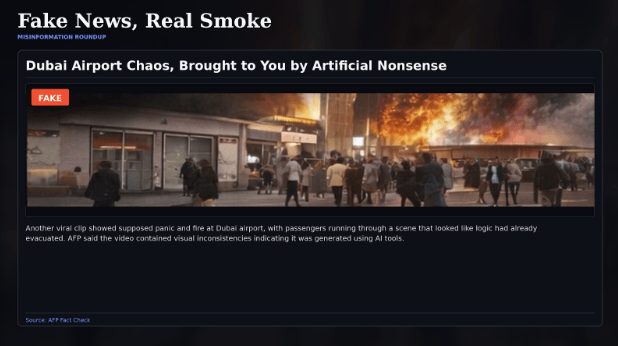
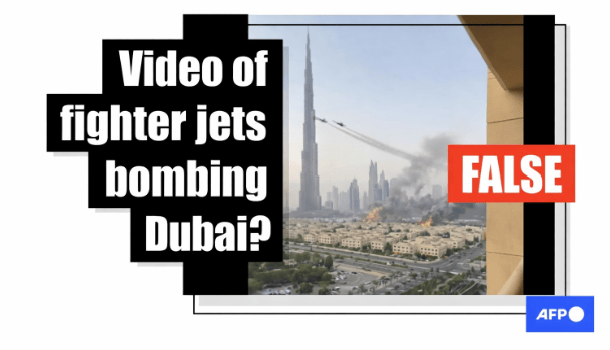
Reuters fact-checked one viral clip that supposedly showed a drone strike on a Citi office in Dubai and found it was actually an explosion in Bahrain. AFP separately showed that footage circulated as a fresh missile strike on Jebel Ali was really from a 2021 port fire. AFP fact-checked an AI-generated clip that falsely appeared to show chaos at Dubai airport. Another widely shared video purporting to show Dubai “under attack” near the Burj Khalifa was traced back to an account that regularly posts AI-generated content, and was later reposted with a disclaimer that it was not real footage.
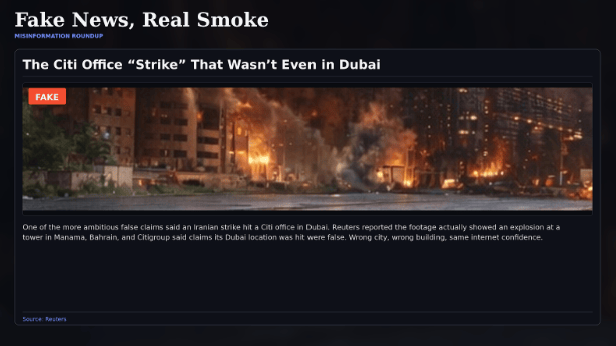
Other viral “proof” was not even new. Reuters found that one clip shared as an attack on “CIA headquarters” in Dubai was actually a 2015 apartment fire in Sharjah. AFP and other fact-checkers also traced fresh panic posts about a supposed strike on Dubai airport to older, unrelated fire footage. In other words, a lot of the internet is not reporting the war. It is cosplay with smoke effects.
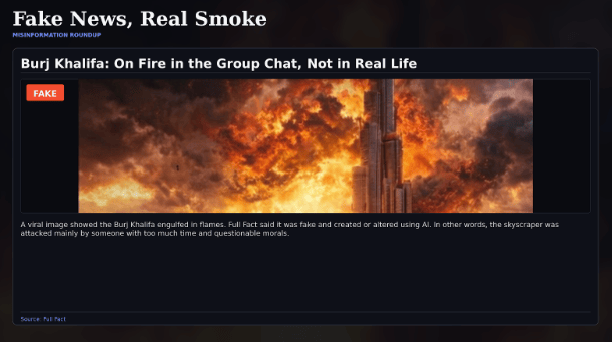
That matters because once fake footage piles on top of real events, people stop distinguishing between “serious but contained disruption” and “the city is over.” One is reality. The other is what happens when the algorithm starts sweating.

The Information War Is Real Too
The UAE Attorney-General has explicitly warned against sharing fabricated clips or digitally manipulated scenes falsely claiming missile strikes or attacks on facilities that did not occur. The government also held media briefings stressing protection of residents, continuity of essential services, and economic stability. That is a fair point in Dubai’s favor: the authorities do not pretend nothing is happening. They communicate, they give instructions, and they try to keep the UAE functioning without whipping people into hysteria.
To be precise, the response has been both calm and tightly controlled.
The state has pushed people toward official channels, warned against rumor-spreading, and made clear that fake or misleading content would be treated seriously. Whether one loves that model or not, it has helped prevent total informational chaos at a moment when the internet is doing its absolute best impression of a gas leak.
Leadership Does More Than Just Issue Statements
One reason many residents have remained steadier than outside coverage suggests is that leadership has been visibly present. Sheikh Mohamed bin Zayed regularly visits the few people injured in the attacks while they receive hospital treatment. Reporting from WAM and The National says he met injured residents and expatriates from several countries and has repeatedly praised the public’s solidarity and adherence to safety guidance.
That is not the only symbolic move. Amid heightened tension, Sheikh Mohamed and Sheikh Hamdan were seen dining and walking through Dubai Mall among shoppers, greeting residents and tourists. Separately, Sheikh Hamdan convened a Dubai Majlis with nearly 300 senior business leaders to discuss measures to reinforce resilience and sustain economic momentum. Public reassurance is not everything, but it is not nothing either. When people see leadership out in the open, engaging with residents and the business community instead of vanishing behind a curtain, it sends a message: we are here, we are watching, and the machine is still running.
There were also practical measures almost immediately. The UAE recommended remote work for much of the private sector in the early days, and later extended distance learning and flexible remote-work arrangements for caregivers to protect students and maintain continuity. That is what competent crisis management looks like in real life.
Even the Animal Response Says Something About the City
One of the more quietly human details was Dubai Municipality’s launch of “Ehsan Stations,” AI-enabled feeding stations for stray animals. Officially, the initiative is designed to identify stray animals, dispense food, support a more organized feeding system, and balance animal welfare with public health and environmental goals. However, it was also timely as a significant number of horrible humans (IMHO) fled and abandoned their pets.
Eshan Stations may sound like a small thing in a regional crisis, but it is also exactly the kind of thing people remember. Cities show their character in how they handle the vulnerable, not just the visible.
The Defense Performance Has Been Pretty Damn Impressive
Now to the obvious question: are the air defenses actually working?
Yes. Not perfectly, because no real defence system is magic, but by official counts they have been highly effective. On March 8, the UAE said it detected 17 ballistic missiles and 117 drones, intercepting 16 missiles and 113 drones. That is an interception rate above 96%. By March 24, the UAE’s air defences had intercepted 357 ballistic missiles, 15 cruise missiles, and 1,806 UAVs since the start of the attacks.
So the fair statement is not “nothing got through,” because some debris fell and some projectiles were not intercepted before landing in the sea or within territory. The fair statement is that the country’s defence capabilities prove real, substantial, and repeatedly operational under sustained pressure. That is what the official daily and cumulative tallies show.
Is Dubai Still Safe?
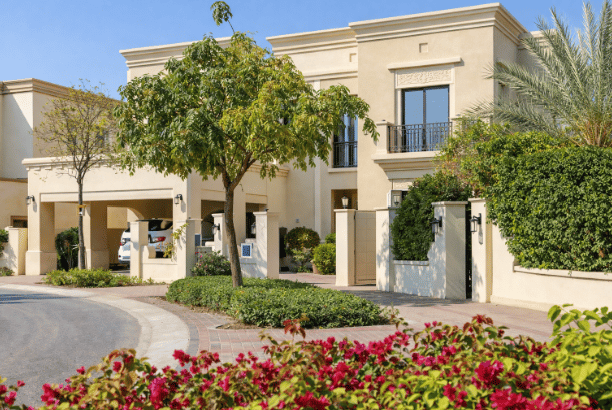
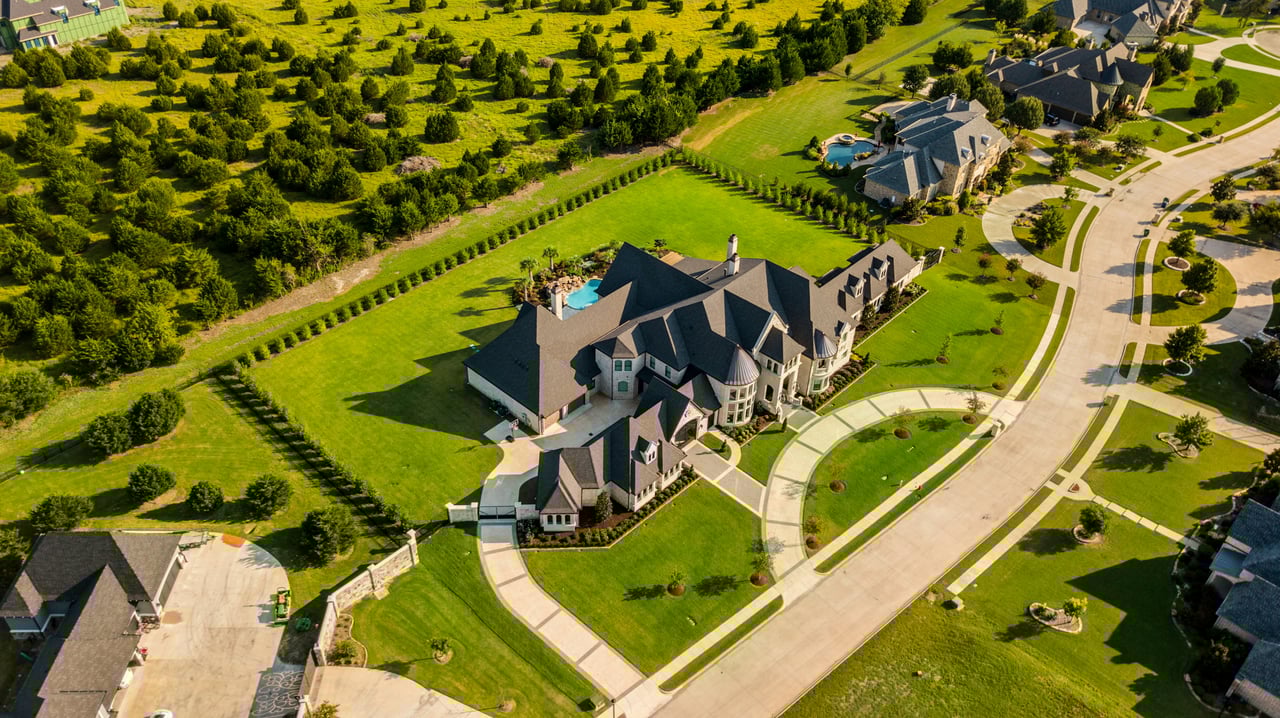
Villa in Arabian Ranches, Dubai
This is where honesty matters more than branding.
If by “safe” you mean “free from geopolitical risk,” then obviously no. March answered that. Dubai, like the rest of the Gulf, can be affected by regional conflict. Pretending otherwise is unserious.
But if by “safe” you mean everyday lived safety, homicide, street crime, theft, mugging, and whether residents feel secure walking around the city, then Dubai still compares extremely well against most Western cities. Numbeo’s current city comparisons show Dubai with a crime index around 16 and safety around 84, versus roughly 55 crime and 45 safety for London, about 51 crime and 49 safety for New York, and about 58 crime and 42 safety for Paris. On Dubai’s own city page, worries about mugging, car theft, being attacked, or walking alone at night all remain in the “very high safety” range. Kids are still out at 9pm riding their bikes around their neighborhoods. Imagine that in the West on a normal day.
That distinction matters because critics often do a bait and switch. They take a real wartime risk, then use it to imply that daily life in Dubai has suddenly become more dangerous than daily life in London, Paris, or New York. That is not what the evidence shows.
Some Coverage Has Been Criticism. Some of It Has Been Schadenfreude.
There is a difference between sober scrutiny and people almost rooting for collapse. Some of the commentary about Dubai this month has felt less like journalism and more like pent-up resentment finally getting a costume change. That does not mean all criticism is unfair. It means one should be careful about sources that seem emotionally invested in proving the city deserved this.
Dubai is not beyond critique. It never was and nowhere is. But some of the glee in the misinformation cycle has been impossible to miss. And that is exactly why facts matter more than vibes, recycled clips, or AI-generated explosions from accounts named things like “WorldTruthNow_47.”
Final Sip
So, is Dubai really “over”?
It is bruised. It is under pressure. Its safe-haven aura has taken a hit. Investors have become more cautious. Residents have been rattled. That is all real.
But the city is still functioning. And much of the online “proof” of total collapse turned out to be fake, old, manipulated, or wildly miscaptioned.
Dubai is not over. The UAE is not over.
It is being tested, publicly and brutally, in front of a world that is half watching and half doom-scrolling.
And so far, the facts do not support the obituary. They support something harder, and maybe more impressive: a city forced to prove what is real beneath the branding.